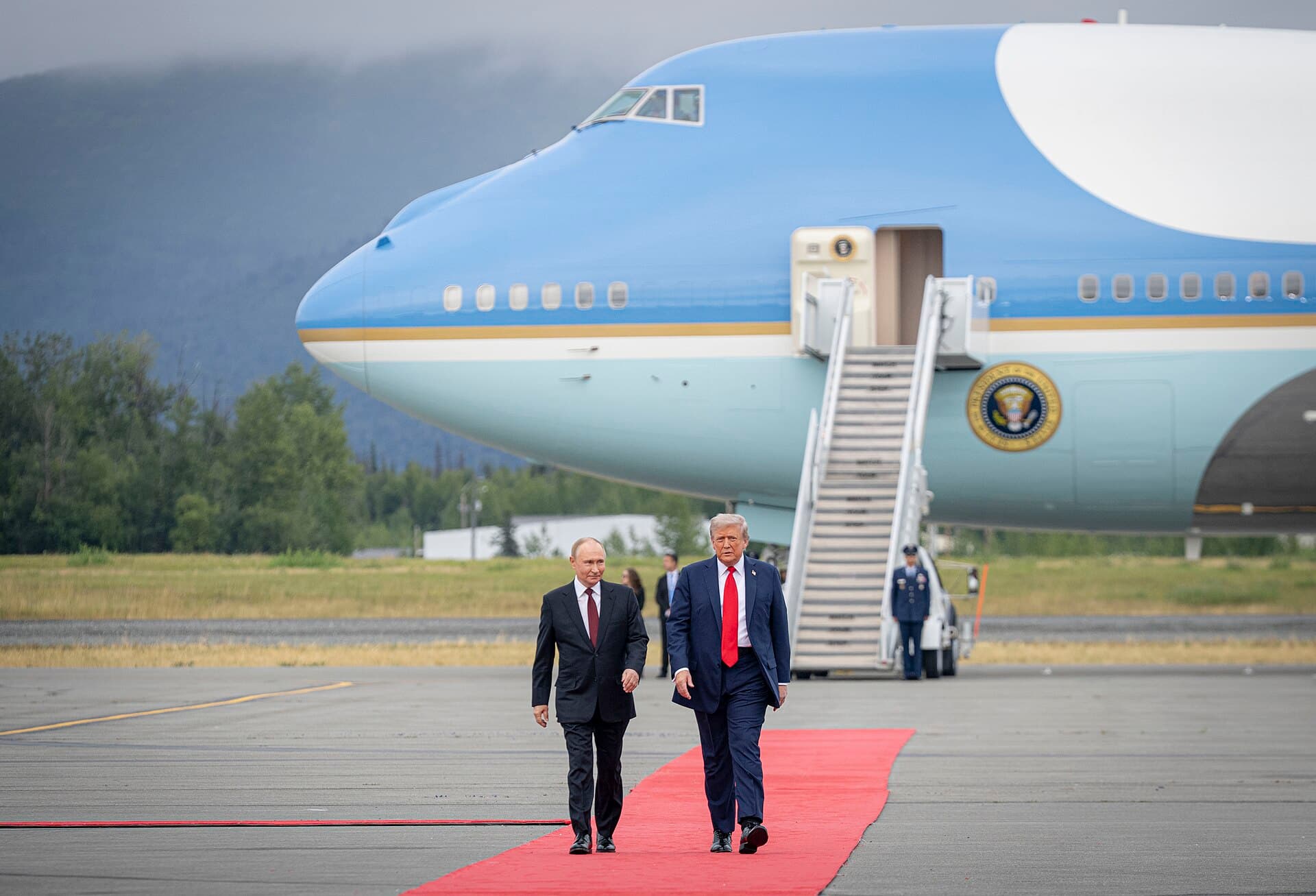
Donald Trump returned to the White House promising to end the war in Ukraine quickly. Nearly two years later, there is still no ceasefire. His envoys have held dozens of meetings, Trump has met Vladimir Putin in Alaska and Volodymyr Zelensky in the Oval Office several times, and the U.S. has alternated between pressuring Kyiv and sanctioning Moscow.
The core obstacle has not changed: Russia wants Ukraine to give up the parts of the Donetsk region it still holds, stay out of NATO and limit its military. Ukraine and its European allies say that would reward the invasion and invite another one.
Timeline
March 2025 — A partial truce
After a heated Oval Office meeting with Zelensky in February, the U.S. and Ukraine proposed a 30-day ceasefire. In a March 18 call with Trump, Putin agreed only to halt strikes on energy infrastructure, and said a key condition for peace was an end to Western military and intelligence aid to Ukraine (Al Jazeera). Both sides soon accused each other of violating the energy truce; Ukraine's military said its special forces had blown up an ammunition depot at Engels-2, a Russian bomber base about 450 miles from Ukrainian-held territory. At the end of March, an exasperated Trump threatened "secondary tariffs" on countries that buy Russian oil if Moscow blocked a deal.
April 2025 — Rifts with Kyiv
After a five-hour meeting with Putin, U.S. envoy Steve Witkoff said the war came down to "these so-called five territories" — Crimea and the four regions Russia claims. Zelensky accused him of "spreading Russian narratives." Zelensky also said Ukraine had evidence that China was supplying Russia with artillery and gunpowder. Russia declared it had pushed Ukrainian forces out of its Kursk region, eight months after their surprise incursion, and acknowledged that North Korean troops had fought there; Ukraine's General Staff claimed Russia lost more than 62,000 troops in the Kursk campaign. Japan agreed to lend Ukraine about $3 billion, to be repaid from profits on frozen Russian assets.
May–June 2025 — Direct talks and Operation Spiderweb
Russian and Ukrainian delegations met in Istanbul for the first direct talks since 2022, producing large prisoner exchanges but no ceasefire. On June 1, Ukraine used drones smuggled into Russia on trucks to strike strategic bombers at airfields deep inside the country.
August 15, 2025 — The Alaska summit
Trump hosted Putin at Joint Base Elmendorf-Richardson in Anchorage. The leaders called the talks productive, but they announced no ceasefire or deal, and Trump said afterward, "There's no deal until there's a deal" (Al Jazeera; Christian Science Monitor). Days later, Zelensky returned to the White House accompanied by European leaders.
October 2025 — Pressure on both sides
Zelensky said a single night of Russian attacks on Oct. 5 used 549 missiles and drones containing more than 102,000 foreign-made components, accusing companies in the U.S., China, Europe and elsewhere of failing to stop parts from reaching Russia. At an Oct. 17 White House meeting, Trump declined Ukraine's request for Tomahawk cruise missiles and urged both sides to stop the fighting where it was. Finland's president, Alexander Stubb, said his country would never recognize Russia's annexations. On Oct. 22, the U.S. imposed its first major sanctions of Trump's second term on Russia, targeting the oil giants Rosneft and Lukoil, and a planned Trump-Putin summit in Budapest was called off (Novaya Gazeta Europe).
November 2025 — The 28-point plan
A U.S. peace plan drafted by Witkoff and Trump's son-in-law Jared Kushner after meetings with Kremlin envoy Kirill Dmitriev would have required Ukraine to give up the rest of the Donbas, cap its army and abandon NATO membership. European leaders called it a capitulation; after talks in Geneva, the U.S. and Ukraine pared it to a shorter framework of about 20 points (Al Jazeera; Axios).
December 2025 — Talks in Berlin and Moscow, money from Europe
Witkoff and Kushner met Zelensky in Berlin and spent nearly five hours with Putin in the Kremlin without a breakthrough. EU leaders agreed to lend Ukraine €90 billion for 2026 and 2027, funded by EU borrowing, after Belgium blocked a plan to finance it directly with frozen Russian assets; those assets will stay frozen until Russia pays reparations (AP, via KSAT).
February 2026 — Geneva
The U.S. set a June deadline for a deal (Euronews). Three-way talks among the U.S., Russia and Ukraine in Geneva on Feb. 17–18 produced an agreement on a large prisoner exchange, but no progress on territory; Russia still demanded the rest of Donetsk (Euromaidan Press). Around the same time, Russian forces completed the capture of the eastern city of Pokrovsk (see our Battle of Pokrovsk explainer).
July–September 2026 — NATO pledges, envoys in Kyiv
At their summit in Ankara in July, NATO leaders pledged €70 billion for Ukraine (Al Jazeera). In September, Witkoff and Kushner made their first visit to Kyiv.
October 9, 2026 — The diesel deal
In a call with Trump, Putin said peace talks were unlikely to resume soon, citing Ukrainian drone strikes on Moscow during Russia's parliamentary elections. After the call, Trump announced that Russia would deliver more than 300,000 tonnes of diesel to U.S. and global markets and declared an "energy truce." Zelensky called the deal a "gift to Putin," and European allies said they would keep up sanctions (Al Jazeera). The New York Times reported that a planned trip to Moscow by Witkoff and Kushner was put on hold (SBS News).
Where things stand now
As of mid-October 2026 there is no ceasefire and no date for new three-way talks. Secretary of State Marco Rubio has called the war a "dangerous stalemate." The Washington Post has reported that the U.S. and European governments are drafting a new proposal built on a ceasefire along the current front line in exchange for security guarantees and economic incentives (Meduza). Meanwhile Russia has stepped up its attacks on Ukraine (CNBC).
Sources
- Al Jazeera, Putin tells Trump peace talks are unlikely, cites Ukraine drone attacks (Oct. 10, 2026)
- Al Jazeera, Russia-Ukraine "peace plan": what's the latest version? (Nov. 26, 2025)
- Al Jazeera, Trump, Putin end short summit without ceasefire deal in Ukraine (Aug. 16, 2025)
- AP, EU leaders agree on 90 billion euro loan to Ukraine (Dec. 19, 2025)
- Novaya Gazeta Europe, US sanctions Rosneft and Lukoil after Trump cancels Budapest summit (Oct. 23, 2025)