In December 2024 Syrian rebels toppled Bashar al-Assad, ending more than five decades of his family's rule and severing Iran's main link to Hezbollah in Lebanon. Over the next two years, the Gaza war went through two ceasefires, the U.S. bombed and then made a truce with Yemen's Houthis, and several Western countries recognized a Palestinian state. Israel and the U.S. fought Iran twice: a 12-day war over its nuclear program in June 2025, and a far larger war that began in February 2026 and killed Supreme Leader Ali Khamenei.
Where each conflict stands
- Iran: After a U.S.-Israeli war that began on Feb. 28, 2026, a Pakistan-brokered ceasefire and a June peace memorandum both broke down. Low-level fighting and a U.S. naval blockade of Iranian ports continue.
- Gaza: A ceasefire under President Trump's 20-point plan has held since October 2025 and all living hostages have been freed, but the plan's second phase — Hamas disarmament and further Israeli withdrawal — has not begun.
- Syria: Ahmed al-Sharaa, the former rebel leader, is president. The U.S. has lifted its main sanctions and he has visited the White House.
- Lebanon: Fighting between Israel and Hezbollah resumed during the Iran war; a new ceasefire took effect in April 2026, though Israeli strikes have continued.
- Yemen: The Houthis say they are honoring a 2025 truce with the U.S., but they have attacked Israel, and a Saudi-led coalition struck Houthi fuel facilities in October 2026.
Timeline
December 2024 — A ceasefire in Lebanon, Assad falls in Syria
Two weeks into a ceasefire between Israel and Hezbollah, Israeli strikes killed six people in two villages in southern Lebanon, according to Lebanon's health ministry — an early sign of a truce that would be repeatedly tested. On Dec. 8, Assad fled to Moscow as rebels led by Hayat Tahrir al-Sham (HTS) took Damascus. Days later, Secretary of State Antony Blinken confirmed that the U.S. was in direct contact with HTS, despite its designation as a terrorist group.
January–March 2025 — Gaza's first ceasefire collapses
A ceasefire took effect on Jan. 19, 2025, and dozens of hostages were exchanged for Palestinian prisoners. With talks on a second phase stalled, Hamas offered in mid-March to release Edan Alexander, an American-Israeli soldier, along with the bodies of four other hostages if Israel implemented the deal. On March 18, Israel resumed large-scale strikes, ending the truce. Alexander was freed in May after direct talks between Hamas and U.S. envoys.
March–May 2025 — Bombing the Houthis
On March 15, Trump ordered a sustained bombing campaign against the Houthis, the Iran-backed rebels who control much of northern Yemen and had attacked shipping in the Red Sea. The group had survived years of Saudi-led airstrikes. In May, Oman brokered a truce in which the Houthis agreed to stop attacking U.S. ships; they said it did not apply to Israel (AP, via Yahoo News).
May 2025 — Trump meets al-Sharaa
In Riyadh, Trump met Syria's new president and announced he would lift U.S. sanctions on Syria.
June 2025 — The 12-day war
Israel launched a wave of strikes on Iran's nuclear and military sites, and Iran fired hundreds of missiles at Israel. On June 22 the U.S. bombed Iran's Fordow, Natanz and Isfahan nuclear facilities. A ceasefire took hold on June 24.
September 2025 — Recognition of a Palestinian state
After months of talks among Britain, France and Saudi Arabia about a coordinated move, the U.K., Canada and Australia recognized a Palestinian state on Sept. 21, followed by France and others at the United Nations. Israel and the U.S. opposed the step.
October 1–6, 2025 — The flotilla
Israeli forces intercepted the "Global Sumud Flotilla," dozens of boats trying to bring aid to Gaza, and detained hundreds of activists, including Greta Thunberg. She later told Swedish officials she had been held in a bedbug-infested cell and made to hold flags for photographs, The Guardian reported; Israel denied mistreating detainees. The activists were deported.
October 10–13, 2025 — The second ceasefire
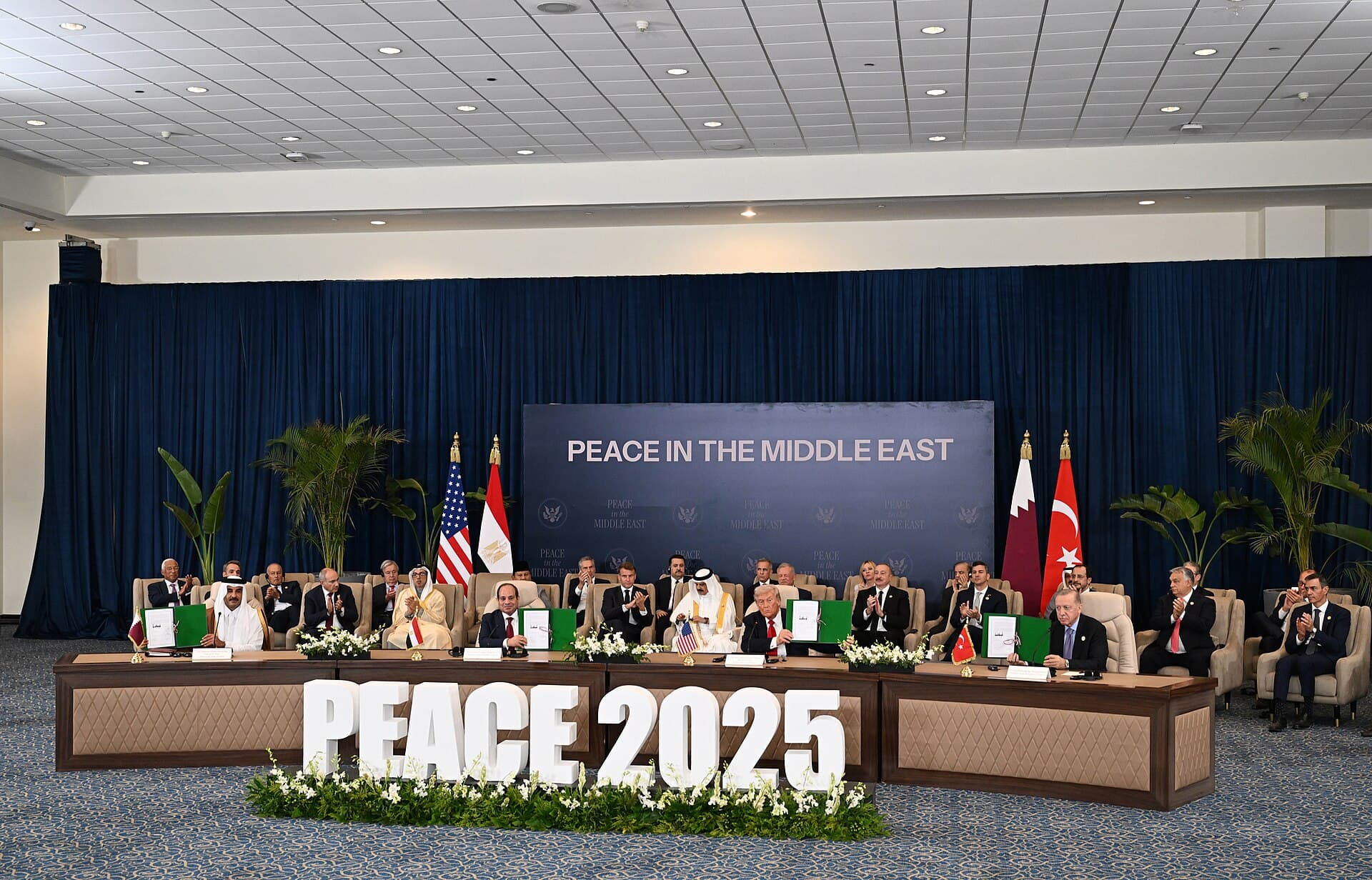
Under Trump's 20-point plan, a ceasefire took effect on Oct. 10. Hamas released the last 20 living hostages on Oct. 13 in exchange for nearly 2,000 Palestinian prisoners and detainees, and world leaders signed a declaration at a summit in Sharm el-Sheikh, Egypt (Council on Foreign Relations).
November–December 2025 — Syria comes in from the cold
Al-Sharaa visited the White House on Nov. 10, the first Syrian president to do so. A week later, the U.N. Security Council authorized Trump's "Board of Peace" to oversee Gaza's transition and an International Stabilization Force. In December, Congress repealed the Caesar Act, the sweeping sanctions imposed on Assad-era Syria, as part of the annual defense bill (The New Arab).
February 28, 2026 — War with Iran
After Iran refused U.S. demands to end all uranium enrichment, the U.S. and Israel launched coordinated strikes on Iran, killing Supreme Leader Ali Khamenei. Trump announced "major combat operations" and urged Iranians to take control of their government. Iran fired missiles at Israel and U.S. bases and allies across the region and moved to close the Strait of Hormuz, the passage for about a fifth of the world's oil (NPR; Council on Foreign Relations). Hezbollah joined the fighting, reigniting war in Lebanon. On March 8, Iran's Assembly of Experts named Khamenei's son, Mojtaba Khamenei, as supreme leader (Al Jazeera).
April–August 2026 — Ceasefires, a memorandum and a collapse
A Pakistan-brokered ceasefire took effect on April 8, followed by the first direct U.S.-Iran talks in decades, in Islamabad; Israel and Lebanon agreed to their own ceasefire in mid-April. On June 17 the U.S. and Iran signed the 14-point Islamabad Memorandum, which called for an end to strikes, a toll-free reopening of the Strait of Hormuz and an end to the U.S. naval blockade of Iranian ports during 60 days of negotiations. It unraveled within weeks: shipping was attacked, strikes resumed in July, the blockade returned, and the memorandum expired in August (Al Jazeera; Al Jazeera).
2026 — Gaza's stalled second phase
U.S. officials began talks on the plan's second phase in January (Al Jazeera). In late July the Board of Peace announced an agreement on disarming Hamas, but Hamas said it would not carry out its part until Israeli forces withdrew further, and Israel did not publicly accept the proposal (Al Jazeera). In September, Houthi representatives told U.S. officials in Oman they remained committed to the 2025 truce.
Where things stand now
The war with Iran overshadows the region. As of mid-October 2026, large-scale strikes have paused but there is no settlement: the U.S. blockade of Iranian ports remains in force, Iran's control over the Strait of Hormuz is disputed, and Pakistan is trying to revive talks. In Gaza, a year after the October 2025 ceasefire, the fighting has largely stopped, but the territory remains divided, with Israeli forces holding a buffer zone in the east. Hamas has not disarmed, the International Stabilization Force has been slow to form, and the plan's other goals have been only partly met (Al Jazeera).
Sources
- Al Jazeera, US-Iran memorandum of understanding expires: how and why it fell apart (Aug. 17, 2026)
- NPR, Iran's supreme leader, Ayatollah Ali Khamenei, has been killed (Feb. 28, 2026)
- Al Jazeera, What has Trump's Board of Peace achieved in a year since the Gaza ceasefire? (Oct. 10, 2026)
- Council on Foreign Relations, A guide to Trump's 20-point Gaza peace deal
- Al Jazeera, Gaza Board of Peace announces Hamas disarmament agreement (July 31, 2026)
- The New Arab, US Senate repeals Caesar Act (December 2025)