For decades, most European members of NATO spent well under the alliance's 2% of GDP guideline on defense. Russia's full-scale invasion of Ukraine began to change that. President Donald Trump's return — and his warnings that the U.S. might not defend allies that don't pay — accelerated it.
In 2025 the European Union unveiled a plan to mobilize up to €800 billion for defense, and NATO allies agreed to a new target of 5% of GDP by 2035. At the same time, Russia stepped up what European officials call hybrid warfare: drones and aircraft probing NATO airspace, sabotage, and interference in elections.
The new targets
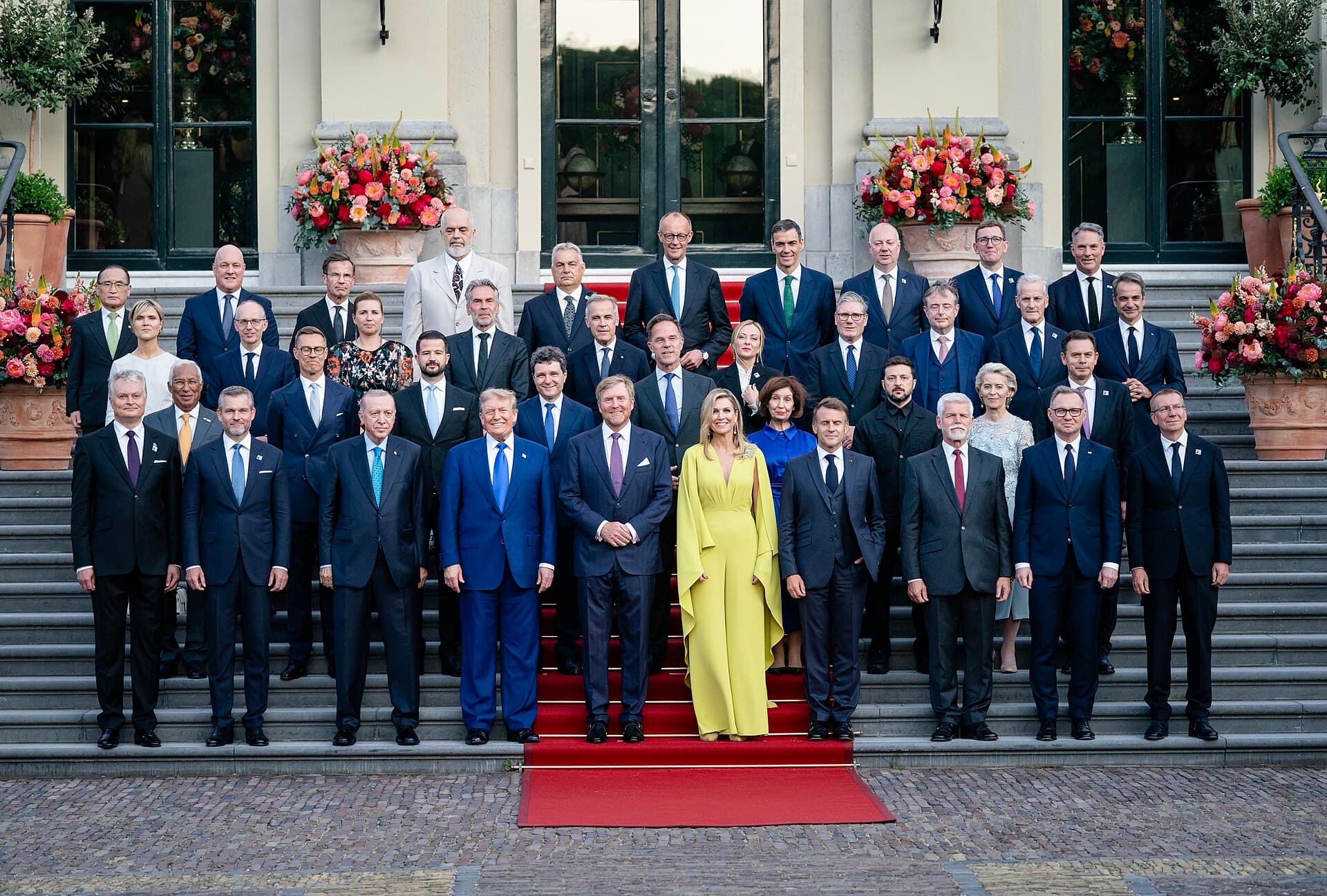
- NATO's goal: 5% of GDP by 2035 — 3.5% on core defense and 1.5% on related spending such as infrastructure and cybersecurity — agreed at the alliance's summit in The Hague in June 2025.
- Progress: In 2026, European allies and Canada are projected to spend 2.53% of GDP on core defense, up from 2.3% in 2025; five of 32 members are projected to reach the 3.5% core goal this year (Al Jazeera).
Timeline
March 2025 — "ReArm Europe"
European Commission President Ursula von der Leyen proposed a plan to raise up to €800 billion for defense, including €150 billion in loans to governments. The push divided some countries: in Rome, tens of thousands of people joined a rally waving EU flags, organized as a show of European unity even as Italy's parties split over spending more on arms. Poland, which held the EU's rotating presidency, began working with Britain on joint ways to finance defense production; Poland already spends more of its GDP on defense than any other NATO member.
May–June 2025 — Poland votes under pressure
Poland's digital affairs minister warned of "an unprecedented attempt" by Russia to interfere in the country's presidential election through cyberattacks and disinformation, citing Poland's role as the main transit hub for Western aid to Ukraine. Karol Nawrocki, a conservative backed by the Law and Justice party, narrowly won the June runoff.
June 24–25, 2025 — The Hague summit
NATO leaders agreed to the 5% target. Trump, who had long demanded that allies pay more, claimed credit for the commitment.
September 9–10, 2025 — Drones over Poland
About 20 Russian drones crossed into Polish airspace, mostly from Belarus, during an attack on Ukraine. Polish F-16s and Dutch F-35s shot several down — the first time NATO forces had engaged Russian drones since the 2022 invasion. Poland invoked Article 4 to request consultations with allies, and NATO launched "Eastern Sentry," a mission to strengthen air defenses along its eastern flank (Kyiv Independent; The Aviationist). Russia said it had not intended to target Poland.
September 2025 — Trump's state visit to Britain
Trump made his second state visit to the U.K., hosted by King Charles III at Windsor Castle. The trip had been in planning since the spring, when an earlier meeting with the king in Scotland was dropped from his schedule.
October 2025 — Spy planes over the Baltic
For the third time in a week, NATO jets intercepted a Russian reconnaissance plane flying near allied airspace over the Baltic Sea with its transponder off and no flight plan. Polish MiG-29s escorted the aircraft away; Poland said it did not enter Polish airspace.
July 7–8, 2026 — The Ankara summit
Meeting in Turkey, allies were pressed to present concrete plans for reaching 5%. The summit declaration cited more than $50 billion in new purchases, focused on air and missile defense and drones, and pledged €70 billion for Ukraine (Al Jazeera; NATO).
Where things stand now
European defense budgets are rising faster than at any time since the Cold War, led by Poland, the Baltic states and Germany, but most allies remain far from 3.5% on core defense. Relations with Washington were also strained by Trump's January 2026 push for Greenland, which ended with a "framework" deal and a dropped tariff threat (see our explainer on Trump's push in the Western Hemisphere). For the war itself, see our timeline of the Russia-Ukraine peace talks.
Sources
- Al Jazeera, Five key takeaways from the NATO summit in Ankara (July 8, 2026)
- NATO, Secretary General previews the Ankara Summit (July 6, 2026)
- Kyiv Independent, NATO to launch Eastern Sentry in response to Russian drone attack on Poland (September 2025)