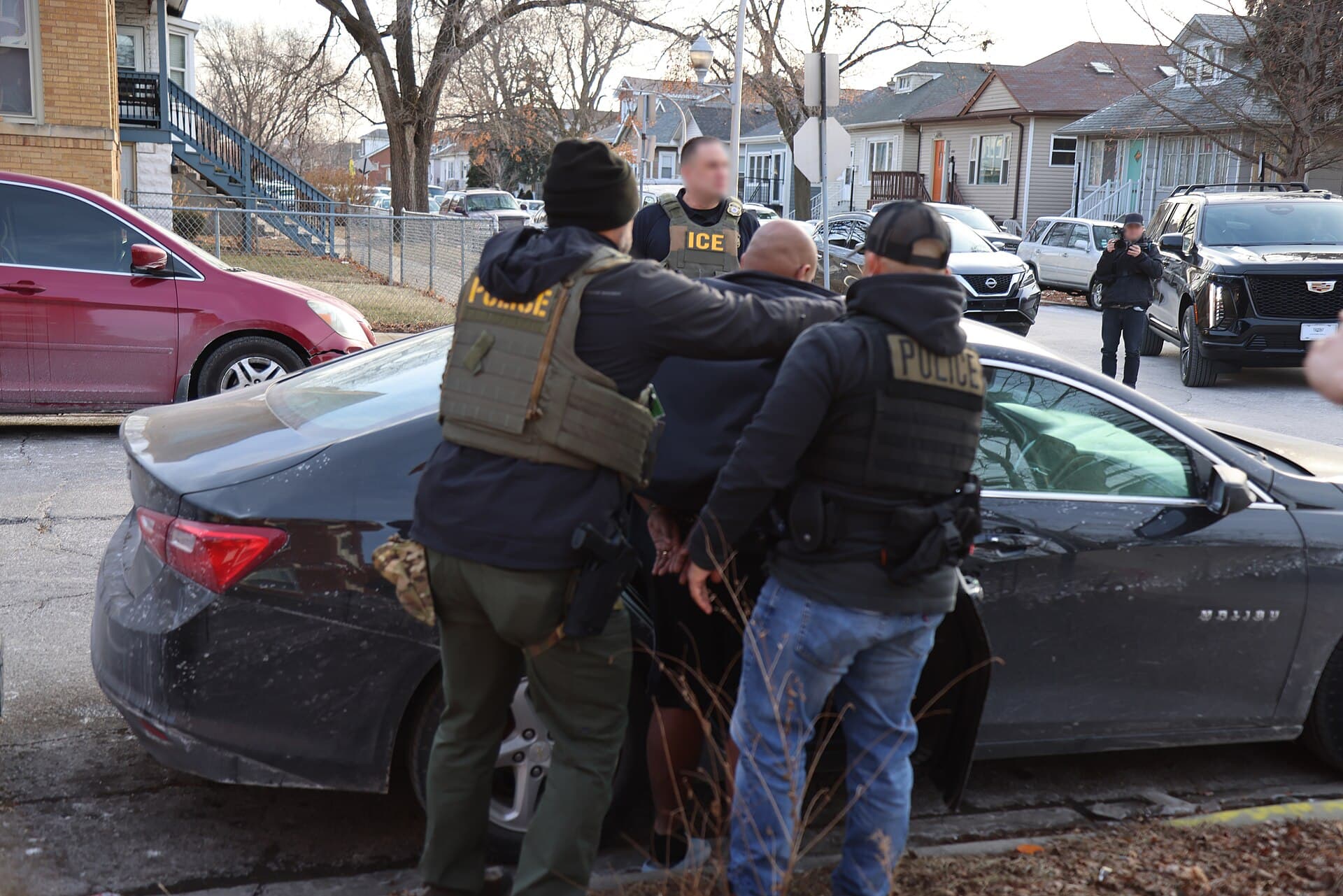
Mass deportation was President Donald Trump's central campaign promise, and his administration has pursued it on a scale not seen in decades. Immigration and Customs Enforcement is holding more people than ever before, has deployed new data and surveillance tools, and has sent deportees to countries they have no connection to.
The campaign has also produced a backlash. Courts have blocked some tactics, local officials have clashed with agents, and the killing of two U.S. citizens by federal agents in Minneapolis in January 2026 led to the removal of Homeland Security Secretary Kristi Noem.
By the numbers
- Detention: ICE held about 73,000 people in custody at its 2026 peak, the most on record; the administration has said it wants room for more than 100,000 (CBS News).
- Deportations: ICE reported more than 350,000 removals in the 2026 fiscal year, putting it on pace to rival the record set under President Barack Obama (ABC News). Independent analysts who track ICE's data report lower totals.
Timeline
2025 — The machinery expands
Congress gave immigration enforcement tens of billions of dollars in new funding, and ICE expanded detention, hired more agents and enlisted local police and other federal agencies. In April, ICE paid Palantir about $30 million to build ImmigrationOS, a platform meant to manage the "immigration lifecycle from identification to removal" and to help target visa overstays (Business Insider, via Yahoo News). Acting ICE Director Todd Lyons described his goal for deportations as running "like Prime, but with human beings."
Summer–fall 2025 — City by city
Large, highly visible operations — with masked agents, Border Patrol units and National Guard support — moved through Los Angeles, Washington, Chicago and other cities, leading to protests and lawsuits. (See our explainer on Trump's National Guard deployments.)
November 2025 — Clashes and mistakes
- Temecula, California: Police arrested an off-duty federal agent who was filmed pointing a gun at a 17-year-old driver he accused of speeding in his neighborhood. He was charged with assault with a deadly weapon and child endangerment. The Department of Homeland Security said he was not an ICE officer; the teen's lawyer said he worked for Customs and Border Protection (KTLA).
- Providence, Rhode Island: ICE agents surrounded a Superior Court judge's car outside the courthouse and briefly detained his high school intern, then acknowledged they had the wrong person. Rhode Island's chief justice called it "an egregious incident" (WPRI; Boston Globe).
- Britain: Across the Atlantic, the U.K.'s Labour government announced its toughest asylum rules in decades: refugee status reviewed every 30 months and, for people who arrive illegally, a 20-year wait for permanent settlement, up from five years (gov.uk).
January 2026 — Minneapolis
During "Operation Metro Surge," which brought about 3,000 federal agents to Minneapolis, an ICE agent shot and killed Renee Good, 37, in her car on Jan. 7. On Jan. 24 federal agents shot and killed Alex Pretti, 37, an intensive care nurse at the city's VA hospital. Both were U.S. citizens. Videos contradicted officials' initial accounts of both shootings, and protests spread nationwide (CNN; NBC News). Trump later put border czar Tom Homan in charge of winding down the operation.
March 2026 — Noem out, Mullin in
After a bruising two-day congressional hearing, Trump announced on March 5 that Noem would leave the Department of Homeland Security (The Washington Post; Al Jazeera). The Senate confirmed Sen. Markwayne Mullin of Oklahoma as her replacement, 54–45 (States Newsroom, via New Jersey Monitor).
June 2026 — Deported to a third country
A U.S. deportation flight carried Iranian, Syrian and Afghan migrants to the Central African Republic under a third-country agreement. Some aboard had won "withholding of removal" from U.S. immigration judges, who found they were more likely than not to be persecuted at home. The administration argues that protection only bars sending people to their home countries, not elsewhere (Al-Monitor).
The tools behind the crackdown
- Data and software. ImmigrationOS and other systems pull together government and commercial records to identify and prioritize targets, raising privacy concerns about how far that data reaches.
- Detention. New and expanded detention centers, many run by private contractors, have pushed the detained population to record levels.
- Third-country removals. Agreements with countries including Ghana, South Sudan and the Central African Republic allow deportations of people who cannot be sent home.
- Local cooperation. Agreements under a program known as 287(g) let local police carry out immigration enforcement.
Where things stand now
As of the latest figures, deportations and detention remain near record highs under Secretary Mullin, and third-country deportations continue despite legal challenges. The Minneapolis killings remain a focus of investigations by journalists and lawmakers, and immigration enforcement is a central issue in the November 2026 midterm campaigns.
Sources
- CNN, 18 days in Minnesota: how immigration agents killed 2 US citizens (July 22, 2026)
- ABC News, ICE says over 350,000 individuals removed so far in fiscal year 2026
- CBS News, ICE's detainee population hits record high of 73,000
- The Washington Post, Trump removes DHS Secretary Kristi Noem (March 5, 2026)
- Al-Monitor, US deportation flight carrying Iranians lands in Central African Republic (June 2026)