Three very different discoveries made headlines between late 2024 and late 2025: a step toward useful quantum computers, a claim that may — or may not — be the first direct detection of dark matter, and evidence that one of the oldest Maya monuments was built as a map of the universe.
Google's quantum chip
What happened
In December 2024, Google unveiled a quantum processor called Willow and published results in the journal Nature showing that its errors went down, rather than up, as it combined more quantum bits, or qubits, into a single "logical" qubit. Quantum computers are extremely sensitive to noise, and error correction that improves as systems grow is considered essential to building machines large enough to be useful.
Why it matters
Experts said the result removed a major technical obstacle and made practical, large-scale quantum computers plausible by the end of the decade. Google also said Willow completed a benchmark calculation in minutes that would take a classical supercomputer longer than the age of the universe — though that test has no practical use, and useful quantum applications such as designing new drugs or materials remain years away.
A possible signal of dark matter
What happened
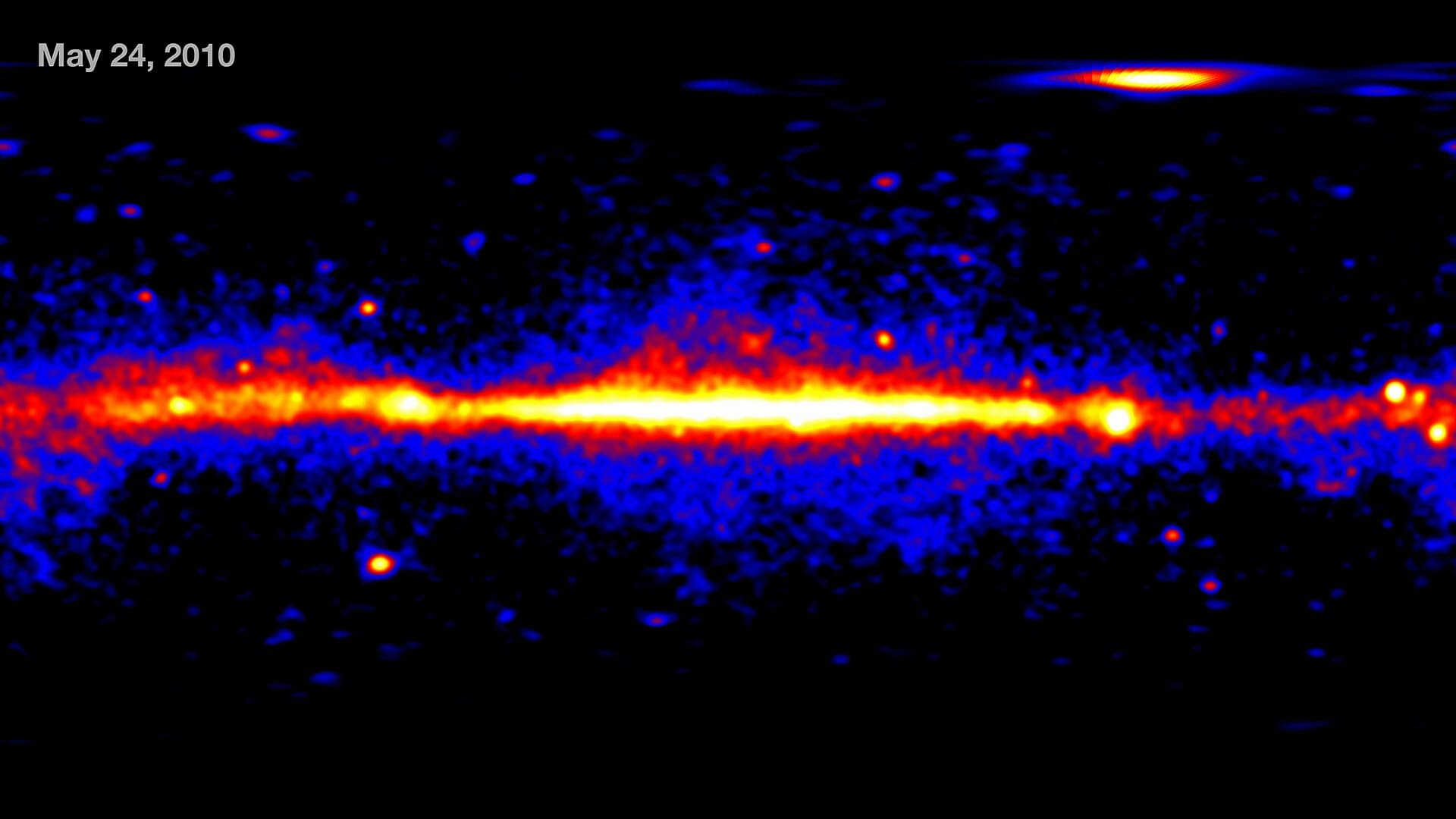
Astronomers believe about 27% of the universe is made of dark matter, an invisible substance detected only through its gravity. In November 2025, Tomonori Totani of the University of Tokyo reported in the Journal of Cosmology and Astroparticle Physics that 15 years of data from NASA's Fermi Gamma-ray Space Telescope show a halo of gamma rays around the center of the Milky Way with an energy pattern matching what physicists predict if dark matter particles were colliding and annihilating each other (study).
The caveats
If confirmed, it would be the first direct detection of dark matter and among the most important discoveries in physics. But other scientists cautioned that ordinary astrophysical sources, such as populations of pulsars, could produce similar signals, and that the claimed particles would need to match observations elsewhere, such as in small satellite galaxies. Independent analyses are needed before the finding can be accepted.
The Maya "cosmogram"
What happened
Aguada Fénix, in the Mexican state of Tabasco, is the largest and one of the oldest known Maya monuments, built around 3,000 years ago. In a study published in Science Advances in late 2025, archaeologists reported that the complex appears to be a cosmogram — a model of the universe laid out on the ground. Beneath the jungle they found a large cross-shaped pit, part of a series of nested cruciform structures linked by canals, aligned to the cardinal directions and containing offerings such as colored mineral pigments placed according to direction (study).
Why it matters
The findings suggest that ideas about the cosmos central to later Maya civilization — including the significance of the four directions — were already guiding monumental construction centuries before the rise of the great Maya cities.
Sources
- Totani, T., Journal of Cosmology and Astroparticle Physics (November 2025)
- Science Advances, Aguada Fénix study (2025)